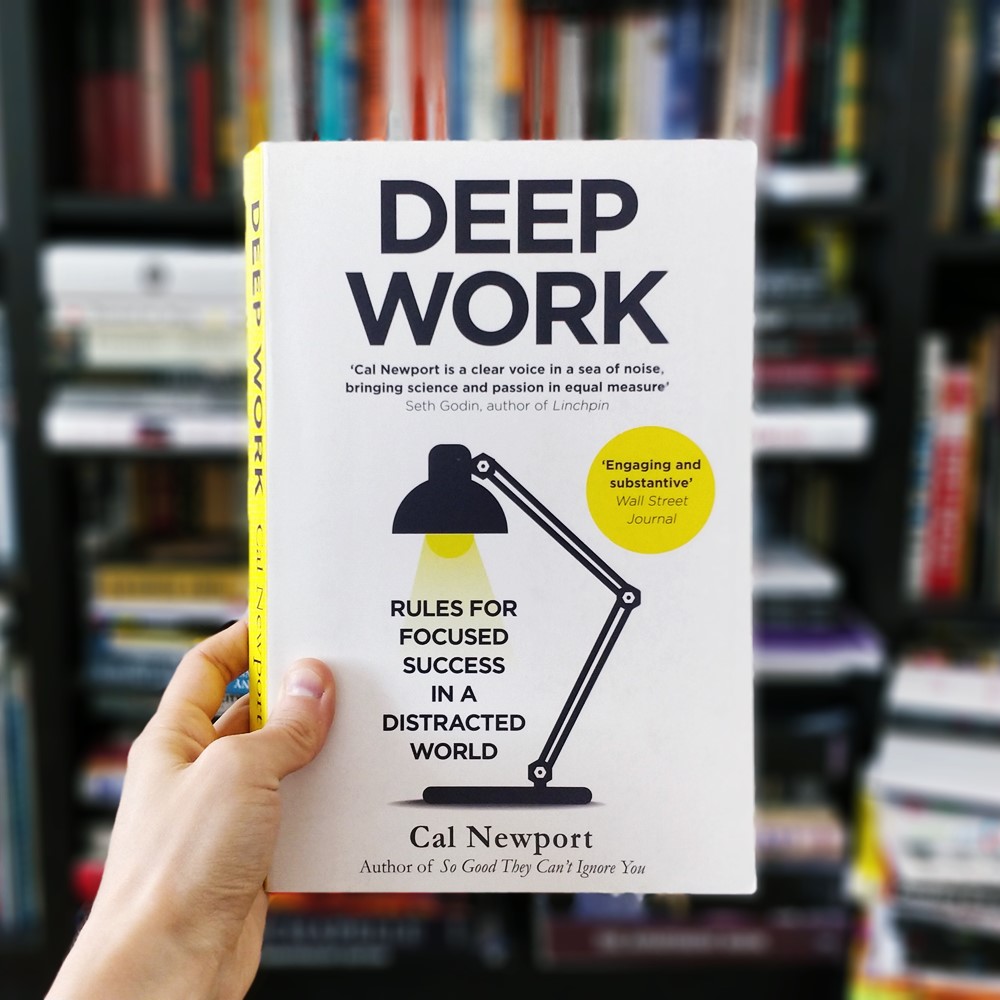
If you are anything like me, you might have an automatic reaction to the books of self-help gurus like those listed in the wrist-damaging concrete block Tools of Titans. In a moment of desperation and self-doubt, you might pick up a book at your local bookstore, hide it behind something more literary, and find a spot away from judging eyes to actually read it.
When you cracked it open, sustained the weight on your wrists, and read the list of people interviewed in the table of contents, your cringe detector kept firing until you shut it down and shelved it next to all the rich-dad titles promising financial freedom.
But then again, once every few years, a title with a noble subtitle might catch your attention—something like “rules for focused success in a distracted world”—and because you are in the bookstore precisely to flee the forces that assault your attention, you pick it up.
Cal Newport is known for his long self-help videos. These videos have a DIY aesthetic to them, almost as if he produced them himself: always him in a portrait shot against a black background, well combed and groomed, with papers aligned on his desk as a tic before he leans into the microphone—a bit out of shot—to speak while looking straight at the camera. When you listen to him speak, he is articulate and slow and often repeats sentences to highlight significance. What I have found lately to be helpful and rare in his videos is a seriousness and dedication to subjects with all their nuances. That is in general what you get a sense of when reading Deep Work.
He also seems part of a wave of writers who are realistic and, dare I say, healthy in how they think about work and productivity. I’m thinking, among others, of Oliver Burkeman (Four Thousand Weeks: Time Management for Mortals), Matthew B. Crawford (The World Beyond Your Head), and Alex Pang (Rest).
This is less of a book review than reading notes—for anyone doing knowledge work who suspects attention is upstream of both craft and sanity. I hope these notes are not mere summarization (some of them are) but a way of engaging the ideas further, and perhaps nudging you toward reading more and developing a sense of meaning in the work you do.
To give you a sense of what he covers in this excellent book, I’ve grouped themes here. The notes are ideas that had an important impact on me, with examples from my own life. I want to highlight that this book has had more impact on me than any other self-help book I’ve read. Re-reading in the era of cheap LLMs, the same frame applies: they can deepen practice or become another attention trap, depending on how deliberately you use them.
Value of deep work
He starts from a pretty cold economic picture—the groups that will do well in this new economy are people defined by their ability to learn hard things and quickly produce high-quality output. The skill that seems to matter most under that story is deliberately practicing for real stretches of time without distractions. I’ve always romanticized that idea but assumed it was too lofty to sustain in practice. What I’ve realized is that deliberate practice can show up in day-to-day work: instead of shooting off that quick message to your teammate, take a moment to write it well and with intention. Next time you have a task you’ve done hundreds of times, do it deliberately—learn something new about what you’ve always assumed, ask your favorite LLM to approach it in a different way, explain it to someone on your team. That is how depth surfaces in small choices, not only in marathon sessions. In hard fields it matters that people producing very good work are those who learned deep work—and maybe more importantly learned to stay away from what breaks concentration. There’s a chapter called Deep Work Is Rare that makes the same point: the value is high because the thing itself is uncommon.
The book is also page after page of reasons why deep work is good. I always thought these nonfiction books were bloated, stretching one idea with long anecdotes that seem to go nowhere, and you can summarize the ideas in a paragraph or two—and that is still true. But you lose something important for the ideas to stick. With age I found the anecdotes are thinking space for me; they make concrete what would otherwise be dry and abstract and pass you by.
When I finished the book, the closing remarks about producing the best work you are capable of were so motivating that I felt energized about my work and pushed to do the best work I am capable of.
Being a young father myself, I found it inspiring to see him putting this work into his career while caring for his family and the pressures of a demanding life. I also remember distinctly, almost ten years ago when I picked up the paperback, finding the prose blunt and amateurish—judgment I can’t defend now. After some hard failures and attempts at writing half-decent prose, I understood how hard it is to write, period, let alone with clarity and structure, and in general to be useful. That’s what this book has been in this period of my life: very useful.
Diagnoses of modern workplaces
I felt something shift when he said there are individuals who will thrive in a distracted world but it’s unlikely that’s us (because we are reading this). His point is that those people benefit tremendously from the disadvantages everyone else lives under (executives, and so on).
His general diagnosis is that businesses, in attempting to increase people’s impact, accidentally leave their employees distracted and scattered. His theory is that it’s hard to measure one person’s contribution to what the company actually produces. I really liked this and only later fully felt its importance. It’s crucial in one’s career to be purposeful about the work we do and the impact it has on the companies we work for. When impact is fuzzy, shallow busy work becomes the default, and I’m still trying to figure this out. How do you separate shallow work (the necessary kind) from deep, meaningful work—and in my case work that enriches the lives of users I make software for, or my teammates, and ultimately the company? Not sure I’ve nailed that.
How recognizable the bit is about meetings becoming the place where people figure out the details of their own work as they go—the whole “this could have been an email” pattern. He ties much of this to busyness as a proxy for productivity (e.g., if we’re in a meeting, we’re working), tracing back to an industrial age where if you weren’t seen on the conveyor belt, you weren’t productive. Of course there’s a place for meetings. Later in the book he gives concrete advice on improving how we work, which matters enormously in post-COVID, remote, async settings—see for example his ongoing writing on knowledge work.
Technology as a tool
There’s a systems-thinking riff in the book I keep returning to: technology has a way of going invisible. You stop asking what it costs, or what it rules out, because it’s just how work is done. When too many tools land too fast, it’s hard to treat any of them as having real trade-offs or long-term consequences; everything blurs into default. Newport argues for pushing back—questioning whether you need the more sophisticated option, stripping what you can, and reaching for simplicity.
Deep work and how it relates to flow state and life’s meaning, and willpower.
Attention matters because it’s what lets your mind and mood size up how good or bad life feels right now. I’m absolutely looking at this from a Buddhist tradition (Vipassana, Dzogchen—here’s an introduction).
In my own experience, doing deep work gives meaning to my life. I think of times when I work on hard projects for long stretches: projects that matter to the people I work with, projects that matter for my family. I feel a lot of joy and meaning. Giving myself completely and deeply to the task at hand has helped me understand more about the nature of my mind and to live a more examined life. Of course that’s not always the case. Sometimes shallow work feels easy, rewarding in the short term, and a little numbing—juggling many things at once. By the end of the day you feel drained, as if you’ve been pulled in a million directions. Cutting back on distraction has a strange effect at first: you get more comfortable with boredom, more comfortable with uneasiness. I believe the more you investigate where that’s coming from instead of pushing it away or trying to get rid of it, the more useful you can be to the people around you.
I like the psychological argument he makes that deep work is conducive to flow—but he distinguishes the two.
The philosophical thread stays a bit on the surface, in my opinion. He vaguely argues that we lost a source of meaning because we lost a common understanding of the sacred, and that an answer might lie in craft and workmanship—and therefore in deep focus. He goes on to say this is not only about work; the subject of depth could be anything. I think of other writers here too, like Matthew Crawford (Shop Class as Soulcraft) and Byung-Chul Han, who explored this more deeply.
The idea that stuck with me is that willpower is a bad primary strategy—you don’t want your whole life to run on forcing yourself—but it’s not irrelevant either. It’s a limited reserve, and worth treating that way.
Strategies for deep work
Mostly about different strategies for deep work at a high level. Monastic—completely off and as deep as you can go, for periods of days and weeks. Rhythmic—short but regular. Finally journalistic, where you switch on and off when you can, with the caveat that it takes practice to work in that last mode.
He notes there seem to be benefits to thinking with others to produce high-quality output—but in a specific way: you meet with like-minded people to accomplish something great, in a focused way. He calls it the whiteboard effect. From my own experience at work, balancing time for deep work with working through ignorance, project ambiguity, technical systems, scope, purpose, and value—and then pairing with others to bring a shared understanding to fruition—feels like magic when it happens with competent people who share the same philosophy.
Practical advice on how to improve your focus and thinking.
He starts from the idea that the ability to focus and be less distracted is trained, and the more you multitask the harder it is for your mind to go deep. There is no such thing as “just” focusing one day; you need to do it repeatedly to get better at it. That point keeps mattering the deeper I go on distraction.
Pauses without distractions or activity help your brain process information. Look at your day and see what time you have to get things done (also known as timeblocking). Active recall as a way of learning—and how that applies to work—has helped me tremendously (lately with learning LangChain).
Focused work can feel so boring and hard to choose over stimulating shallow work that doesn’t require deep focus. It’s depressing to be stuck in that state. In those times it helps to remember that depth is possible and that something meaningful waits on the other side.
He also talked about internet breaks during work. I can adopt that at work: look up specific details online only when needed. If I’m blocked by a question, note it and move on. Ideas to schedule your day and keep track of things as you go: his approach is loose—keep readjusting and stay open to change.
He spends a lot of time on making online communication more effective—what he calls process-centric email: when sending or replying to an email, identify the goal the thread is trying to achieve—for example, synchronizing a plan for an upcoming meeting or agreeing on a time to grab coffee. Next, come up with a process that gets you and your correspondent to that goal while minimizing back-and-forth. Explain that process in the email so you and your recipient are on the same page. This idea alone is worth reading the whole book for. For an engineering-minded person, it’s basically visualizing the process for the current collaboration from beginning to end, then in your next interactions seeing how many decisions you can make, with defaults, and handle in one pass.
Be mindful when your mind wanders off topic or gets stuck in a loop—gently guide it back. Very similar to meditation, where you return to a thought or process. One more useful pattern for unknowns and hard problems: at every step, lay out the variables you have and ask what is needed next. Once you advance one step, see what new information appeared, survey everything again, and ask the same question. Repeat until you reach your goal. That kept me from getting lost in complex projects and in projects with a clear vision but many unknowns.
Shallow work (a bit engineering focused, feel free to skip)
With the rise of LLMs, it’s becoming important to learn what to delegate to them—and what not to. Finding patterns in how you work helps too: I’ve found that generating a footprint (tickets, messages, PR discussion, meeting notes, technical documents) makes it easier to look back—with AI, your team, your manager—and see which parts were deep work and which were shallow.
Importance of reset and disconnecting from work.
Have stretches where you are free from obligations (work, family, life—not all at once; I’m not endorsing monkhood). Rest helps the mind regenerate and perform better the next day. The conscious and unconscious mind can work on problems if you allow rest; they just operate at different levels of abstraction and detail. Rest in nature and in low-stimulus environments lets your brain recover.
From a meditative angle, rest is a bit like meditation. Sam Harris’s framing, which I found helpful: “not a mere improved version of an executive stress ball.” A shutdown routine—a fixed sequence that ends the workday (e.g., closing loops, parking tomorrow’s tasks, stepping away from the desk)—signals to your mind that work is closed. That reduces the “open tab” feeling psychologists associate with unfinished tasks intruding on evening and sleep, so you actually recover. When your mind has rested, focus comes easier the next day; the two ideas are the same coin.
Newport and others cap sustained deep work at roughly one to four hours a day not because the rest of the day is lazy, but because attention and deliberate practice have steep marginal costs; quality depth is scarce, which is exactly why he argues it’s economically and personally valuable. Your ceiling will vary; the point is to protect a small block rather than fantasize about twelve-hour “deep” days.
Closing thoughts
Newport is persuasive about craft and attention; taken alone, that voice can sound like a machine you’re supposed to become. Oliver Burkeman is the useful counterweight: when I listen to him and read his work, I’m struck by how far his ideas run against mainstream productivity culture—try learning these things and taking them seriously, but your life stays messy, and not treating productivity as a religion is ultimately healthier. The question is how to adapt all of this into something that fits you without feeling like hardware running a script.
The insight I keep is that you sometimes recognize what actually works in your life and why, then make very small adjustments—while still leaving room to breathe. (If that sounds relatable, I highly recommend Burkeman’s two latest books.)
As for work in relation to life’s meaning, this post is more about pushing toward the foundations of an examined life; it’s up to you to see what incarnations these ideas take in your daily life.
(2026) Edit: re-reading now, added some references to LLMs.